19 July 2014

Exploring West Africa: Togo & Benin (Part 3)

Exploring West Africa with Silversea's Silver Explorer, starting in Accra, Ghana on 10 April 2013 and ending in Dakkar, Senegal on 26 April 2013.

West African Vodun (Voodoo)

April 12th, 2013


Dance is not very commonly integrated into our Abrahamic religions (Judaism, Christianity, and Islam), but it is widespread among the older religious traditions. It is used as a means to symbolically represent the supernatural world and to tell the stories of the spirits. Dance is usually performed to the rhythm of various musical instruments, and dancers often wear special costumes and masks according to the kind of performance presented. Especially in societies that lack systems of writing, dance becomes a way of telling sacred stories and tales. Specific movements and masks are used to portray different spiritual characters.1
A spirit embodied! (Ganvié, Benin, 2013)

Dancing to the rhythm of drums. We were instructed not to touch the dancing spirits, or else!
(Ganvié, Benin, 2013)

I wonder what these specific spirits are supposed to represent..? (Ganvié, Benin, 2013)

The West African Vodun (or Voodoo) is a word that means spirit. The cosmology of the religion centers around the spirits and other elements of divine essence that govern the Earth. A common misconception is that in West African Vodun spells are cast upon individuals. Whereas the religion really emphasizes on the cult of the ancestors and spirits. Vodun spirits are hierarchal in nature, and form the center of religious life. Adherents of Vodun emphasize ancestor worship and believe that the spirits of the dead live side by side with the world of the living, sort of like how like in Islam the djin is believed to live among people, or in Christianity, where angels are believed to be among us. 

The high priest (on the left) and his family
(Togo, 2013)

Vodun is organized around a creator/creatress deity, Mawu and Lisa. Mawu and Lisa (Goddess and God) to the Ewe is the Supreme Being, who in one tradition bore seven children and gave each rule over a realm of nature - animals, earth, and sea - or else these children are inter-ethnic and related to natural phenomena or to historical or mythical individuals. However, even if the origin of humanity and the world are explained in Vodun mythology, it is not a centered question of the faith. The followers believe that the answer to such question is beyond human reach. Priority is given to the ancestors with them interceding on behalf of their families and descendant towards the Almighty.


The first dance (Togo, 2013)

Future priest and priestess (Togo, 2013)


Vodun priests receive a calling from an oracle, which may come at any moment during their lives. They will then join their clan's convent to pursue spiritual instruction. It is also an oracle that will designate the future high priest and high priestess among the new recruits, establishing an order of succession within the convent.

Blessing the Earth

In Togo, about half the population practices indigenous religions, of which Vodun is by far the largest, with some 2.5 million followers; there may be another million Vodunists among the Ewe of Ghana, as a 13% of the total Ghana population of 20 million are Ewe and 38% of Ghanaians practice traditional religion.
Here are a few pictures from the Vodun ceremony in Togo.


The women were helping this man wash his face for some reason (maybe to cleanse from a bad spirit?) The baby looks unconcerned. 

A spirit seems to be just entering the body of this woman. Notice her face is not painted yet.

The possessed man and woman (with painted white faces) are dancing to heavy drum beats.

As strange as this whole ceremony seems, I understand when someone has a need to just let go. The daily life of these villagers can't be easy. Weekly ceremonies spent among family and friends dancing and chanting is a good way to forget worries for a change, and just relax.

This little boy and I were observing the event from the comfort of our corner.

Under the African sun...
Here are some snacks for after the ceremony...

See you tomorrow in Cotonou, Benin! Au revoir!

1. Stein, Rebecca L., and Philip L. Stain. The Anthropology of Religion, Magic, and Witchcraft. Third ed. Upper Saddle River, NJ: Prentice Hall, 2011. Print.

30 May 2014

Exploring West Africa: Lomé, Togo (Part 2)

Exploring West Africa with Silversea's Silver Explorer, starting in Accra, Ghana on 10 April 2013 and ending in Dakkar, Senegal on 26 April 2013.


April 12th, 2013


Population of Togo (2013 estimate): 7.15 million
Population of Lomé, the capital city (2010 census): (837,437)
Currency: 485 (CFA franc) ~ US$1
Demonym (people from Togo are called): Togolese 
GDP per capita (2012 estimate) = US$ 584 (in Kuwait it’s $45,824)
HDI (2010): 0.459, i.e. 159th 

As soon as we docked in Lomé we got into a tour bus. We had police escorts in front of the bus as well as in the back of the bus. Without their help it would’ve been impossible for us to get to Kpalimé (121km away) and back within the same day.

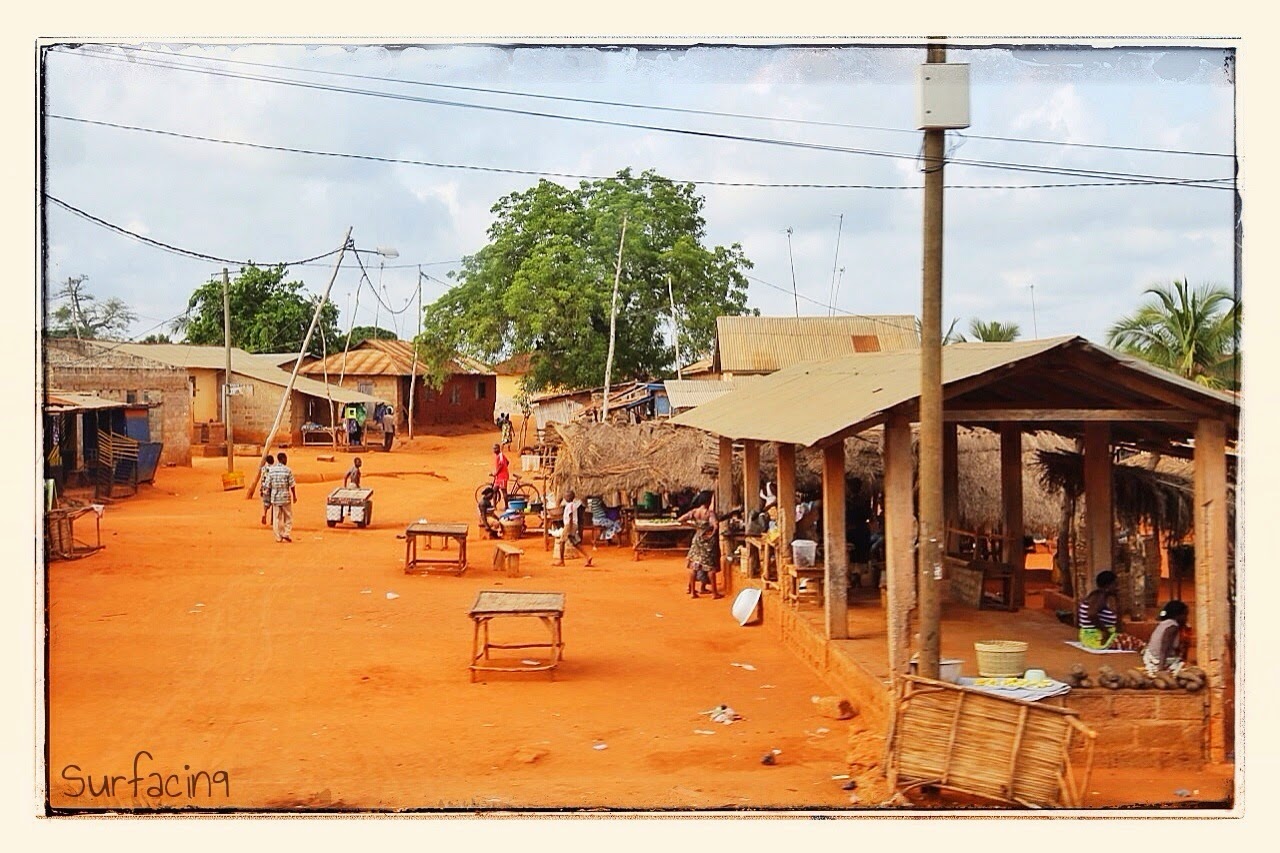
The asphalt road we drove on branched into colorful dirt roads. People traded all kinds of things by the sides of the roads. All text was written in french. Togo gained its independence from France in 1960. Everyone was on motorbike. Drivers wearing yellow shirts were taxi bikes. You could hop on the back seat and enjoy the fresh air to your destination. 


On our way to Kpalimé we stopped at a bush school, which was in a traditional Ewa village. We received a very warm welcome from the locals. Song and dance, football and cheers, women and children, all dressed up for the occasion. 

A welcome song performed by women of this Ewa village 

The students at the bush school were amazing. If somehow we could get the the world to care more about children’s education I believe we’d be able to erase poverty within a single generation.

A school teacher with his students

One of the classrooms in the village

This is what a typical classroom looks like in a West African village


The Ewe are an ethnic group located in Togo. The Ewe are a patrilinear people; the founder of a community was the established chief, and was then usually succeeded by his paternal relatives. In modern times, chiefs are generally elected by consensus and get advice from elders. There are a number of guidelines regarding the behavior of chiefs. They are expected to keep their heads covered in public, and are not to be seen drinking. The people see the chief as the communicator between the every day world and the world of the ancestors. The chief must always keep a clear mind.

The village chief


The Ewe have an intricate collection of dances, which vary between geographical regions and other factors.
One such dance is the Adevu. This is a professional dance that celebrates the hunter. They are meant both to make animals easier to hunt and to give animals a ritual 'funeral' in order to prevent the animal's spirit from returning and harming the hunter.
There are also war dances, peace dances, dances for art and display, dances to invite ancestors to sacred occasions into a shrine.
A dance performance by Ewe women 


Before we got back to our ship, we attended a Voodoo ceremony.. The next post will be devoted to Voodoo!

04 November 2013

Exploring West Africa: Accra, Ghana (Part 1)

Exploring West Africa with Silversea’s Silver Explorer, starting in Accra, Ghana on 10 April 2013 and ending in Dakkar, Senegal on 26 April 2013.

April 9 – 11th, 2013


Population of Ghana (2010): 24.2 million
Population of Accra, the capital city (2012): 2,300,000
Currency: 2 GHS (Ghana Cedis)  = US$1
Demonym (people from Ghana are called): Ghanaian 
GDP per capita (2013) = US$ 1,670 (in Kuwait it’s US$ 45,824)
HDI (2013): 0.558, i.e. 135th 

Accra is like this massive party happening all on its own regardless of what’s going on around the world. Just bring yourself and you’ll be a part of it. Hot and sticky, colorful and loud, you will not get a chance to be alone, not even in your head. Reminds me a little bit of India, although not as humble. Accrans are friendly, warm, and welcoming, but what I really like about them is that they’re bold, upfront, and inquisitive. In a bustling marketplace, as my husband and I walked in a single file behind the tour guide, a woman from the crowd got my attention. Putting on an authoritative face she yelled, “Hey! Heeey! Where’s yo’ yello-feeeva?!” I kept on walking with the river of bodies that carried us deeper and deeper into bargaining and trade, but reluctantly turned my head to see the demanding woman’s face. I spotted her way back, she smiled with a wink. I smiled back, acknowledging that she was just poking fun at us tourists. 


This market had stalls specializing in everything imaginable. There was a vendor for belts, another one sold jeans. One for electric fans, another for remote controls. There was one for laundry baskets and hangers, and another for tape. Yes tape! Different shapes and sizes! I bought a few meters of Kente cloth. I was supposed to bargain, but I hate playing that game, and I thought the price was reasonable, so I bought it without arguments. Turned out the exchange rate I calculated in my head was off by an entire decimal, and I ended up paying for it way more than I thought. Lesson learned. Always bargain. And using a currency calculator App won’t hurt either.

The roll of Kente cloth I purchased. What do I do with it?

Woman selling tape
Woman selling jeans


We visited what they call a compound, which is basically a community that lives together sharing water sources, electricity and such. This tour, as well as the earlier tour we took in the city were arranged by Easy Track Ghana. Their office is based in the compounds of Kisseman. Jessie, our tour guide, took us to their office where we met with Steve. They explained the activities of the community and took us around to see how people live. It was an unforgettable experience.  
The office of Easy Track Ghana
Jessie and his son


The butcher
Car repair shop


The hair saloon

Woman frying fish

Vegetable market

If you’re thinking of going to Ghana, Easy Track provides a good list of items that are much appreciated as charitable donations.


Jessie invited us to his home, where we met with his wife and son.

At the entrance to Jessie's home
Jessie's wife prepared us lunch.
We ate while watching Ghanaian TV drama ;-)


Adding flavour to the dish!
I smell something cooking...


We also saw the gym..


I left Accra all pumped up about the rest of our West Africa trip. People in this part of the world know how to have a good time and I was ecstatic about spending the rest of my vacation days getting to know the history and culture.

Back in the city


And so we se sail aboard Silver Explorer on the evening of April 11th 2013.


14 July 2013

Out of Africa: The Origin of Our Species (Part 10)


Language and Speech


Note: I started reading Africa: A Biography of the Continent by John Reader. The following posts will basically summarize what I find interesting in the book as I’m reading it. None of the ideas or thoughts are of my own. 

It comes without saying that language and speech were only possible with the development of the brain. Together, they pushed the evolution of homo sapiens to what it is today. Large segments of the neocortex, the most recently evolved portion of the cerebral cortex, is wired with neural circuits that transmit the capacity to comprehend language and develop speech. These are one of the most distinguished specializations within our species.

The process appears to have started around 1.5 million years ago with Homo Erectus (see Part 5), whose fossils show that the voice box was already present and whose brain size was significantly large, making it very capable to develop some kind of linguistic communication. Some language experts have pointed out that the most ancient surviving languages came from Africa. However, this theory is widely debated since no tangible proof can be produced about the root origin of language.

Richard Wrangham, a professor of biological anthropology at Harvard University and a co-director of the Kibale Chimpanzee Project, found that within groups of the Gombe chimpanzees social groupings and individual behavior were highly dependent on the availability of food. When all members of the group are well fed and satisfied they tend to have playful interactions and overall peaceful existence. However, when food is scarce, the behavior of the individual becomes to maximize selfish satisfaction, which makes the chimpanzees behave in a less altruistic manner.

Wrangham also studied the ecology and behavior of the Mbuti people of the Ituri rainforest in the Democratic Republic of Congo. He found that language gives the advantage of keeping a level of understanding instead of resorting to physical conflict; when otherwise in a case of chimpanzees violence would’ve inevitably erupted, people extend the line of verbal communication. This observation came about when a group of hunters of the Mbuti pygmies had killed an elephant (a rare event in the community) and brought the caracas to the village. Soon others from nearby communities joined, excitement erupted, and the atmosphere got tense. While the hunters worked on cutting up the parts of the animal, tight groups of people were pushing, shoving, and shouting about who gets what. Eventually the hunters were told by the people of the village to honor the obligations of kinship and give meat to their relatives. Old debts and favors were exchanged for meat, and new deals were made. Talking reduced the fighting. 

Language was only made possible after the evolutionary stages that hominids went through in the African savannas. Teeth and jaws evolved such that the species would be able to eat a varied diet of vegetable and animal foods (see Part 4), the naked skin and upright stance allowed the species to roam around during the hottest hour of the day (see Part 7), and the whole body system allowed for the development of a large cognitive brain (see Part 8) in which reason was put before immediate instinct. These adaptations were all beneficial in their own right, each evolving as a consequence of the environment and whatever the pre-existing circumstance was at the time; none was "designed" to facilitate future evolutionary development. Together they created the circumstance from which speech and language evolved. 

Thanking a group of Ewe kids for letting me have my picture taken with them (Togo, 2013).

Robin Dunbar, a professor of Evolutionary Psychology at the University of Oxford, concluded that language is a response to social imperatives primarily, and related to hunting and gathering only secondarily. He also noted that there is a strong correlation between the size of the neocortex among primates and the size and social complexity of the group in which they lived: the larger the neocortex the larger the social group. Lemurs for example, with a small neocortex in proportion to the rest of their brain, live in groups of less than five. Chimpanzees, with four times the ratio of the neocortex to the rest of the brain, live in groups of fifty five. So in evolutionary terms, the correlation between larger neocortex and group size suggests that the benefit of living in larger groups had been the selective advantage which favored the evolution of the primate’s brain. What size of a group does this trend predict for the ratio of human neocortex to brain? 148 individuals in a group (see Dunbar’s Number).

Individuals are not consciously aware of this number, so what does hold them together in groups of just the right number?

Among primates in general, and apes in particular, individuals live in a web of interactive relationships that are formed and enforced by the act of grooming. The practical purpose is to remove insects and debris from the pelt, but grooming also provides the means to express pleasure and reconciliation between members of the group. Wrangham predicts that was the elephant incident to occur with a group of chimpanzees like it did with the Mbuti people, the chimpanzees would’ve spent hours grooming each other after the event in an attempt to mend the harm done. 

The problem with grooming as a process of communication and bonding within a social group is time consuming. And the amount of time devoted to grooming is proportional to the number of individuals in the group. If a group of chimpanzees consists of about 55 chimps, and they spend 20% of their time grooming, social primates in human-size groups of 150 would have to devote 35% to 45% of their time to grooming. This would take a significant amount of time from any group of species. It would’ve been impossible for human ancestors to keep up with roaming the planes of Africa in search of food resources, in high heat conditions, with that much attention given to grooming. Dunbar suggests that language took human evolution through the grooming constraint on group size, and the size of the neocortex was large enough to handle this change. 

As a result, people talk, and unlike with grooming, they have the ability to do so while engaging in other activities, and they can address several individuals at the same time. Dunbar also points out that since talking replaced grooming for the sake of making communication more efficient, and as grooming can only happen 1:1, the talker should be able to communicate at a ratio higher than that, i.e. to be able to communicate at the same time to more than one person. This ratio is calculated (148 ÷ 55), the ratio of human group of 148 to a chimpanzee group of 55 gives 1:2.7 (one speaker and 2.7 listeners, making a group of 3.7 individuals). He found that the conversation groups he monitored indeed consisted of 3.4 individuals on average. A group larger then four members had the tendency to fragment into two or more smaller conversation groups. As for the topic of conversation, Dunbar observed that social relationships and personal experiences accounted for about 70% for conversation time, half of which was about people not present. As it turns out, it is pretty important to exchange information about people who are not present because it allows humans to coordinate social relationships effectively among dispersed groups.

One more picture from Togo!